Type “futanari” into a text-to-image generator and watch what happens. Fantasy AI image modification offers a different approach, using an existing image as the foundation for adding fantasy elements while keeping the original anatomy and visual structure more consistent. You get a body that looks half-finished, proportions stretched to absurdity, limbs blurring at the joints, anatomy that reads more like a glitch than a fantasy. The more excited the prompt gets, the worse the result becomes.
The problem is not the technology. The problem is that text-to-image generators were never built for impossible anatomy.
They were trained on a world of standard bodies. When you ask for fantasy modifications, the model reaches into its training data, finds fragments of what you want, and smears them together. The result is a Frankenstein, technically impressive, anatomically wrong.
But there is a better way. And it is the same way Hollywood creates impossible bodies: not by inventing from nothing, but by starting with a real performer and adding the fantasy on top.
The Paradox: Why More Detail Creates More Distortion
Every text-to-image generator works the same way. It converts your words into a statistical guess. It has no idea what a human body actually looks like from the inside. And It just knows what collections of pixels usually accompany certain words.
When you ask for a standard body, the guess works. The model has millions of examples to average. But when you ask for something that does not exist in nature, a fusion of anatomy, an added feature, a modified silhouette, the model has no ground truth. It invents one by averaging fragments of things that are close.
That is why the hands break. That is why the torso twists. And That is why the proportions go alien. The generator is not understanding your fantasy. It is guessing at a hallucination.
Fantasy AI Image Modification: The VFX Supervisor Approach
Now think about how a film like Avatar or Pacific Rim actually creates impossible bodies. They don’t ask an algorithm to invent one from nothing. They start with a real actor, on a real set, with real lighting, and then a team of artists, VFX supervisors, modelers, texture artists, adds the impossible layers on top.
The base is real. The fantasy is an addition.
This is the principle behind image-to-image masking, and it is the exact solution to the Futanari paradox. Instead of generating a full image from a prompt, you start with a photograph of a real body. A base that has correct proportions, correct lighting, correct bone structure, correct skin texture. Then you apply a targeted modification to the specific region you want to change.
The base stays true. The fantasy becomes an overlay.
Why DreamPaint Fixes What Generators Break
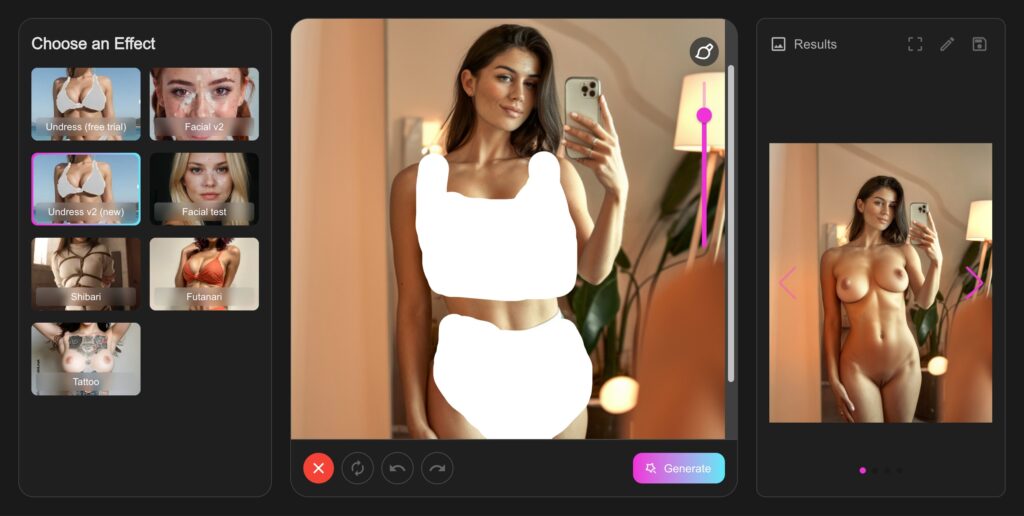
DreamPaint operates on that VFX model. You upload a source image, a photo, a character render, anything with a solid anatomical foundation. The AI studies the structure: the skeleton, the muscle flow, the way light falls across the surface. Then it applies exactly the modification you choose, and only that modification.
Add a fantasy element? The surrounding anatomy does not warp. The ribs stay where they are. The hips keep their natural geometry. The added feature is inserted with an understanding of how it would sit on a real frame, because the real frame is right there in the file, holding everything in place.
The result is not a generated approximation. It is a directed special effect — a body that could exist if biology were slightly more adventurous, rendered with the same visual consistency as the photograph you started with.
The Difference Between “Rendered” and “Composited”
Generators render. Editors composite. The distinction matters immensely.
Rendering is pulling pixels out of thin air. Compositing is layering new elements over existing ones, with full knowledge of the original scene. When you composite, you preserve the authenticity of the base, the shadow of a jawline, the texture of skin, the fall of light, and add only what you need.
This is why an image-to-image editor like DreamPaint produces fantasy bodies that feel real. Not because the AI is smarter, but because it is working with a foundation. It’s like a tattoo artist who knows exactly where the skin curves and where the muscle flexes before they begin inking.
A text-to-image model will give you a Futanari that looks like it was drawn by a committee that had never seen a human body. An image-to-image editor gives you a version that looks like a photograph of something that just might exist. This is where fantasy AI image modification has an advantage: the existing image provides a visual foundation, while the AI focuses on modifying the selected elements instead of recreating the entire scene.
The Fidelity Problem: Keeping the Face You Fell For
There is another reason text-to-image fails hardest in this genre: consistency.
Fantasy content is often about a character. A specific face, a specific aesthetic, a specific vibe the user has already fallen for. When you run a prompt through a generator, you get a new face every single time. You cannot build an attachment because the subject keeps changing.
DreamPaint locks the identity. The face you upload is the face that appears in every result, no matter what effect you apply. The fantasy element can change, the anatomy can evolve, the scene can shift, but the person stays the same. That consistency is what turns a one-off image into a personal archive.
It is the difference between looking at a stranger’s fantasy and entering your own.
Special Effects That Respect the Body
DreamPaint’s effects are designed for this kind of precise work. Undress mechanics work with the body’s geometry rather than against it. Breast release alters fabric tension while leaving the root of the chest untouched. And for fantasy modifications, the tool offers the kind of control VFX artists would recognize, targeted, layerable, and reversible.
You can build a scene step by step. Start with a base image, apply a full naked effect to establish the body, then layer a fantasy modification on top. Because each step preserves the output of the previous one, the final composite carries a consistency that prompt-based generation can never approach.
It is like stacking physical effects on a film set. Every layer has to sit naturally on the one beneath it, or the illusion collapses.
The Creative Workflow: Iterate Until It Feels Inevitable
The real advantage of the editing workflow is that you can work like an art director. Generate a version. Look at the proportions. Adjust the effect. Try a slightly different base. Compare the two side by side. Iterate until the composition feels so right you forget it was ever unreal.
With text-to-image, iteration is a lottery. Each roll of the dice gives you a new cast, a new lighting scheme, a new accident. With image-to-image, iteration is a refinement. The subject stays. The lighting stays. Only the element you are developing changes.
This is how professional character art gets made. Not by chance, but by directed, disciplined revision. With fantasy AI image modification, this iterative process becomes more controlled because the creator can refine the fantasy element while keeping the underlying image consistent.
Privacy for the Shapeshifter
Creating fantasy content means working with source material you care about. That material deserves protection.
DreamPaint’s architecture takes this seriously. Every uploaded image is automatically deleted from the servers after 48 hours. Every generated result is wiped with it. Nothing lingers in a permanent archive, waiting to surface in a context you never planned for.
The same logic extends to payment. Cryptocurrency options like Solana, Tron, and Litecoin settle transactions without attaching a name. No bank statement line, no billing address, no thread connecting your identity to the shapeshifter you built in private.
Final Thoughts
The Futanari and fantasy anatomy paradox is not about the limitation of AI. It is about choosing the wrong tool for the task. A text-to-image generator is a sketch artist — it can suggest an idea, but it distorts the details. An image-to-image editor is a special effects supervisor — it takes a real body and composes the impossible on top with full respect for the foundation.
If you want fantasy that looks like it walked out of a high-budget film, stop asking the generator to cast it. Start with a photograph you love, give it to a tool that understands structure, and let the effect be an addition rather than a reinvention.
The future of digital shapeshifting belongs to the editors.