Every adult category has the same final frame, and almost no AI tool can render it honestly. The load lands, the shot holds, and the image is supposed to look like it was captured two seconds after something physical happened. Instead it looks like someone squeezed toothpaste onto a photograph in MS Paint.
That failure is not a taste problem or a luck problem. Fluid is the hardest thing an image model has to fake, and the cum shot AI category is where the fakes get caught fastest. Which also makes it the category where the right kind of tool finally pays off.
Why Cum Breaks Generators
Liquid does not obey the logic a language model understands. It does not tile, it does not repeat in patterns, and it has no fixed shape to average toward. A text-to-image model asked for a cumshot has seen ten thousand of them and learned one lesson from all of them: it is white, it is on skin, and it is roughly blobby.
So the model paints a blob. It sits on the surface like cream from a tube — uniform opacity, even edges, no weight. Real fluid is uneven by definition. A run has a head and a tail. A bead holds its dome until gravity wins. A landing splatters with a crown, then settles into a pool with a meniscus at the edge. None of that survives an averaged prediction. The model is not simulating liquid; it is decorating a location.
Then there is the second half of the frame, the half that actually sells the shot: the face. A generated cumshot comes with a generated face, which means the expression is invented — usually slightly wrong, always slightly generic, and never the same twice. You generate the same prompt five times and get five different women reacting to the same moment. None of them are anyone.
The Fix: Edit the Moment, Don’t Draw It
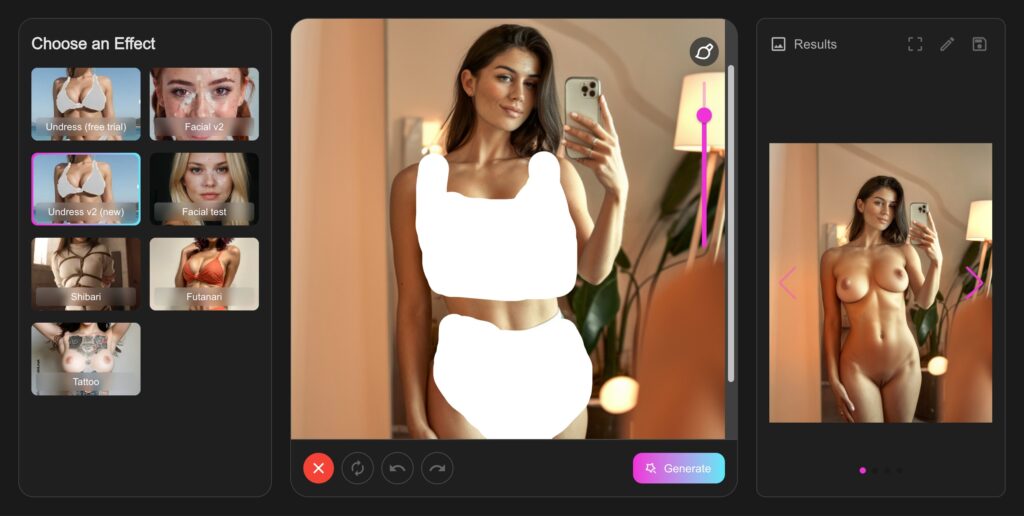
The distinction that separates a usable cum shot AI result from a deleted one is the same distinction running through every serious edit on Dreampaint: the tool should be removing and adding within a real frame, not redrawing the frame from a prompt.
When you upload a photograph — your own, your partner’s with her permission, or a source you have rights to — the image already carries everything the hard part needs. Real skin with real pores and real micro-shine. Real light, with a single consistent direction. A real pose, already balanced and already physical. And a real face, mid-expression, caught at the exact second you want.
The AI’s job shrinks to the one thing it can genuinely do well: synthesising the fluid itself and compositing it into that frame at the right scale, the right viscosity and the right specular behaviour. Because the model is working against an actual image rather than a guess, the load obeys the light that is already in the photo. Highlights line up. Shadow sits underneath the run. Skin shows through where the fluid is thin and hides where it is thick. That is not decoration; that is a composite.
The Effects: Picking Your Ending
The library covers the category the way an actual scene covers it, from the tease to the final frame.
Cum on face is the classic. The AI distributes across the forehead, lids, cheek and mouth with believable variation — heavier deposits where a real load lands, thin trails where it starts to move. Cum on breasts reads as weight: fluid collecting in the cleavage, running in the line gravity gives it, holding a highlight along the top edge. And Cum on ass behaves differently again — wider, flatter, slower, the way liquid spreads on a taut surface.
Cum on pussy is the one most tools lose entirely, because here the fluid has to interact with anatomy rather than sit next to it. The editor approach wins on exactly this: the anatomy came from your source photo, so the fluid follows folds that exist instead of folds the model invented. Facial, run at close crop, is the purest version of the test — a face filling the frame, expression locked, and the whole shot resting on whether the landing looks wet.
Because the source image is never redrawn, the person stays the person. The same face that opened the sequence closes it. That is the quiet miracle of the category: the cumshot is the least consistent part of a real photoshoot and the face is the most, and this is the workflow that keeps it that way round.
Building the Sequence
One cumshot image is a thumbnail. Four is a story, and story is what makes an audience come back tomorrow.
A reliable structure: start with a portrait, composed and dry. Move through the undress or interaction effects so the encounter escalates with the same identity in every frame. Land on the cum shot. Then — and this is the step almost nobody takes — run Ruined Mascara or Ruined Makeup as the closing frame. Streaked liner, a bitten-out lipstick, fluid still catching light in the crease of her cheek. That final image does more work than the cumshot itself, because it implies the twenty seconds after.
Every step in that chain preserves the output of the previous one. Same face, same body, same light logic, from the doorway to the aftermath. A prompt-based generator hands you four unrelated women and asks you to believe in them. An editor hands you one woman and lets you watch her.
Making It Land on the First Generate
Source photos decide the ceiling. Best results come from images where the target area is clearly visible and well lit, eyes open for facial work, resolution high enough to show skin texture, and lighting soft enough that the added fluid has something consistent to reflect. A harsh on-camera flash flattens the frame and the composite sits on top of it like a decal. Heavy beauty filters have already erased the pores the fluid needs to cling to.
Then commit to iteration rather than one hero generation. Real cumshot shoots are won on the third or fourth take, and the credit model exists for exactly that. Run the same source at low, medium and heavy load. Change only the effect, keep the source constant, and the differences become obvious in a minute of looking.
And treat restraint as a tool. The most effective frames in this category are not the ones drenched wall to wall — they are the ones with a single run down the jaw and one bead on the lower lip, because scarcity tells the eye this is a photograph and excess tells it this is art.
Privacy, Because This Category Especially Needs It
These are not images most people want attached to their name, and the workflow handles that at both ends. Dreampaint deletes every uploaded image from its servers automatically after 48 hours, and the generated results are wiped with them — no permanent library, no archive waiting to surface in a context you never planned for. Payments go through Solana, Tron or Litecoin, which carry no name and no billing address, so nothing on a statement connects the person who paid to the frames that were made. No subscription, no renewal jump, credits spent only when you want them:
- Basic – $29: 100 credits, doubled to 200 with crypto
- Premium – $39: 300 credits, doubled to 400 with crypto
- Platinum – $69: 1,000 credits, doubled to 1,100 with crypto — the best per-credit rate
The fluid effects sit at the affordable end of the library for the same reason mechanics sit cheap in any craft: the tool expects you to make several.
Final Thoughts
The cum shot AI category is the stress test the medium cannot bluff its way through. Fluid exposes a fake instantly, and the face at the end of the shot exposes it permanently. That is why the winners here will not be the generators with the most explicit vocabulary — it will be the editors that understood the shot was never about drawing.
It was about putting something wet into a real frame without disturbing a single pixel of the person already standing in it. Upload the photo. Pick the ending. Get back the same face, the same light, the same second — and a load you would not be embarrassed to post.
Anyone can generate a white smear. Getting it to catch the light, run where gravity pulls it, and land on a face that is still recognisably hers — that is the shot.