Type a sentence, get a picture. That is the promise every text-to-image tool makes, and on the surface it sounds like magic. No source photo, no preparation, no limits. Just words in, image out.
Then you try it on something that matters — a real face, a specific person, a body you actually care about — and the magic collapses. The result looks close to what you asked for and nothing like who you wanted.
That gap is not a bug waiting to be fixed. It is structural. Text-to-image and image-to-image solve two completely different problems, and for NSFW work, only one of them solves yours.
What Text-to-Image Actually Does
A text-to-image model has no memory of anyone. It has never seen the person in your head. When you type “woman, brown hair, athletic,” the model reaches into its training data and assembles a statistical average of every image it has ever studied that matches those words.
The output is a composite. A face that resembles a thousand faces and belongs to none of them. Skin with the right texture and the wrong proportions. Eyes that sit a few millimetres too far apart, teeth that blur at the edges, hands that fold into themselves like wet paper.
None of this is a flaw in the model. The model was built to invent, and inventing means averaging. Averages are the enemy of identity.
The Identity Problem Nobody Warns You About
Here is the test that ends the argument. Generate the same prompt five times. You get five different people. Run the same prompt a week later with the same settings and you get a sixth. Nothing is preserved, because nothing was ever anchored.
Now imagine you want a specific person — a favourite creator, a character from a show, an image you have saved for years. Text-to-image cannot deliver her. It can deliver a stranger who roughly matches her description. Fans spot that instantly. A face that shifts between frames breaks the fantasy faster than anything else on screen.
For adult content, identity is not a nice-to-have. It is the entire product.
What Image-to-Image Editing Does Differently
Image-to-image starts with an actual photograph. The face exists. The proportions exist. The lighting, the bone structure, the exact curve of a jawline — all of it is already in the file before the model touches anything.
The editor’s job is not to invent a person. It is to alter the scene around a person who already exists. That is a far smaller, far more controllable task. The model preserves what matters and modifies what you asked it to modify.
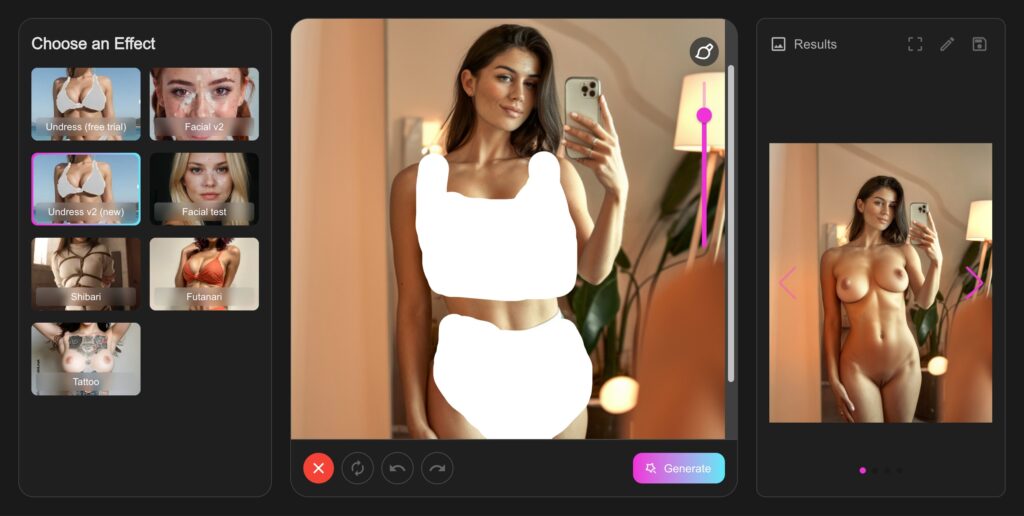
This is why tools like Dreampaint focus on editing rather than generation. Upload an image you already love, choose an effect, and the result keeps the original identity intact while the scene changes around it. Undress removes clothing without rearranging the face. Cumshot overlays land on the same person who was in the photo. Tattoo and Shibari modifications wrap around the actual body instead of a stranger’s approximation of it.
Futanari edits work the same way. The base image stays recognisable. Only the requested element changes.
Why Consistency Beats Volume
A generator gives you unlimited images of nobody. An editor gives you unlimited variations of somebody specific.
That difference shows up the moment you build a set. Ten generated images of “a woman” look like ten unrelated photos from ten different shoots. Ten edited images of the same source photo look like a coherent series — the same face, the same body, the same person across every frame.
For creators, that consistency is what builds a page worth following. For fans, it is what makes a clip feel personal instead of borrowed. Nobody subscribes to an average.
Cost And Speed: The Hidden Difference
Text-to-image sounds cheaper because it needs no input. In practice it burns money. You generate, you reject, you regenerate, you tweak the prompt, you reject again. Ten attempts to get one usable frame is a normal ratio. Twelve usable frames might cost you a hundred generations.
Editing flips that ratio. One source photo plus one effect usually equals one usable result, first or second try. Fewer credits, less waiting, less frustration.
Speed matters just as much. Dreampaint runs entirely in your browser — no software to install, no editing timeline to learn, no render queue to babysit. Results land in minutes, and the packages stay cheap because you are not paying for the model to guess.
Where Editing Wins, Effect By Effect
Every popular NSFW effect is an edit, not a generation.
Nudify and Undress only work if the face survives. Generation destroys it.
Cumshot overlays need correct positioning on a real body. Generators place them roughly and hope.
Tattoos have to sit on real skin, following real contours and real light.
Shibari requires rope to wrap around actual anatomy, with tension that reads as physical.
Futanari modifications depend on the original body staying recognisable underneath.
Try any of these with a text prompt and you get a rough approximation of the concept attached to a stranger. Try them with an editor and you get the person you chose, in the scene you asked for.
Text-to-Image Still Has A Place
To be fair, generation is not useless. It is excellent for backgrounds, textures, mood boards, and rough concept work. When the subject does not matter, prompting is fast and fun.
It only fails when the subject is the point. And in adult content, the subject is always the point.
Privacy And Control
A good editor also respects what you give it. Dreampaint deletes every uploaded image automatically after two days, and removes the generated output along with it. Nothing lingers on a server waiting to surface later.
You keep the original. You keep the control. And You keep the person you actually wanted.
Final Thoughts
Text-to-image invents a stranger. Image-to-image transforms someone real.
For adult content, that is the whole difference between a novelty and something you actually want to keep. Generators impress for a minute. Editors deliver the face, the body, and the fantasy you started with.
One upload, one effect, one result that still looks like her. That is what Dreampaint was built for.